We live disconnected from our Nature
I believe that our suffering comes ultimately from disconnection to our true nature.
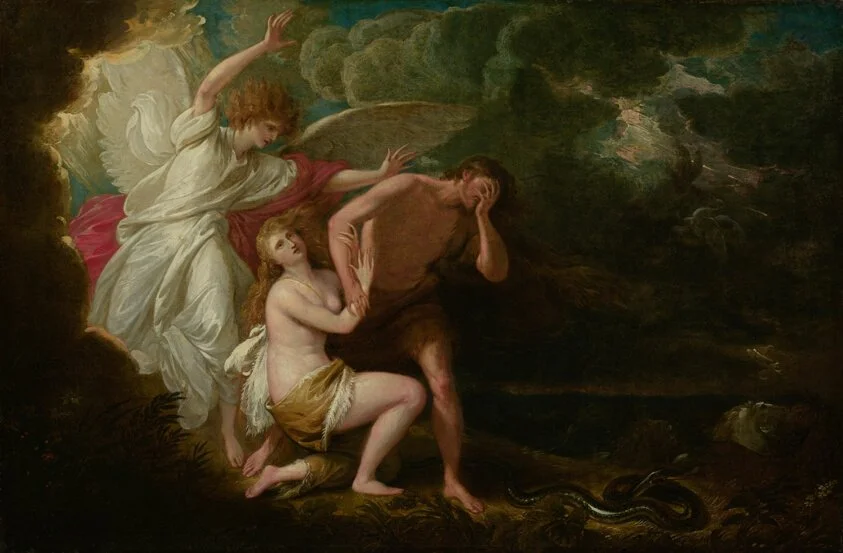
The Expulsion of Adam and Eve from Paradise (1791) by Benjamin West (1738–1820). Oil on canvas.
This disconnection comes from several traditions, and has many interpretations. In Western culture, it is framed in the tradition of exile from the Garden of Eden, from the womb, or from the warm bosom of our parents home when we come of age. Buddhist tradition would say, however, that this separation is an illusion and that we are always connected in spite of our lack of awareness.
Whether a metaphysical illusion, biological necessity, or cultural expectation—we are hurting.
I use an archetypal understanding of disconnection, separateness, and loneliness, and it forms the ground of my work. It’s a tender human truth, a place where we can all feel a little more empathy for each other.
Our Natures have a reason for existing
Our Nature has a purpose!
Our Nature, our true self, intentionally includes things we often pathologize: narcissism, depression, anxiety, addictions, ADHD, perfectionism, procrastination, grandiosity, insecurity. Our Nature, however, also includes our gifts, diagnoses, temperaments, tendencies, sensitivities, and pet peeves.
I have found that, if met with unflinching curiosity, these phenomena reveal more than a simple diagnosis. They are rather, more like the tumbling facets of a kaleidoscope –colorful and perpetually changing. We don’t have to pursue change – it is constant and always present. Change is in our Nature. My job is to be present as the scope spins, and to provide external insight into the new patterns as they tumble and develop.
Grandiosity, as an example
I am allergic to therapy (or coaching) that dogmatically pursues becoming, “the best version of yourself”. This steamrolling over our Natures to some contrived vision of artificial transcendence denies the value and purpose of your current system and why it is there. Our Natures have a purpose. They were constructed for a reason.
As an example, maybe you are experiencing grandiosity in a way that feels powerful, but is causing you to lose friends. Don’t just cast grandiosity out, along with its power! Instead, let’s turn the kaleidoscope to a new perspective. Let’s see if there is an angle where grandiosity is potent and relational – where it is powerful and attractive to our friends. Maybe we will discover that these friends could use a little grandiosity for themselves.
Rather than reducing grandiosity to a stereotype, let’s meet it as a full being, with its many faces. Let’s shift the scope from lowercase grandiosity, the inanimate concept, to uppercase Grandiosity – the personified being. Now, let’s introduce ourselves to Grandiosity, who like any being, wants not to be analyzed, but rather to be understood.
When met on its own terms, Grandiosity is no longer only a stereotyped villain. This is not to say the new arrangement is inherently better. It only means we’ve struck upon a design that works for your relationship with Grandiosity – a structure that supports your desire for power, friendship, and alignment with your Nature. This is far more powerful than someone else’s idea of transcendence.
What “Meet you where you’re at” means
To “meet you where you’re at” means I stay attuned and present with you. There is no false promise, no hidden agenda. When change happens, it doesn’t come from destruction or elimination. We add perspective. We add a new lens. We discover a new facet.
Beauty will save the world
In this way, we stay connected to Nature, to our Nature, even if it includes jealousy, rage, and hopelessness. To deny or attempt to eliminate these feelings is to attempt to annihilate our Nature. Instead, I invite my clients to practice the art of being with all of it.
This practice does not let these phenomena off the hook. There are very real world impacts of mental and emotional pain, which we take seriously. I take it so seriously, that I will come back to them, time and again, with an openness and alert curiosity. A nonjudgemental presence helps to catch things, to find obscure patterns, and to make meaningful connections.
If we are too fixated on categorizing grandiosity as good or bad, we will miss the story it is trying to tell.
I am not, however, neutral or without opinion. If anything, engaging from a non-moralizing place allows me to stay with the phenomena longer, and to form a deeper understanding of what is happening. We focus on exploration, rather than moralizing, and through this, my opinion grows stronger.
I stay with the phenomena and practice seeing it as it is. This, to me, is true kindness and compassion. To practice seeing someone as they are, and loving them because of, not in spite of, the very parts of their Nature they would rather disregard.
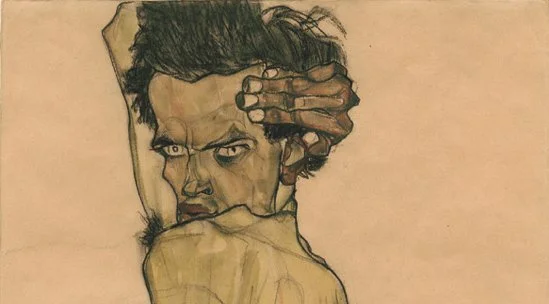
Egon Schiele, Self-Portrait with Arm Twisted above Head, 1910. Watercolor and charcoal.